Claude Code sandbox mode: what it actually stops an unattended agent from doing
10 min read
On this page
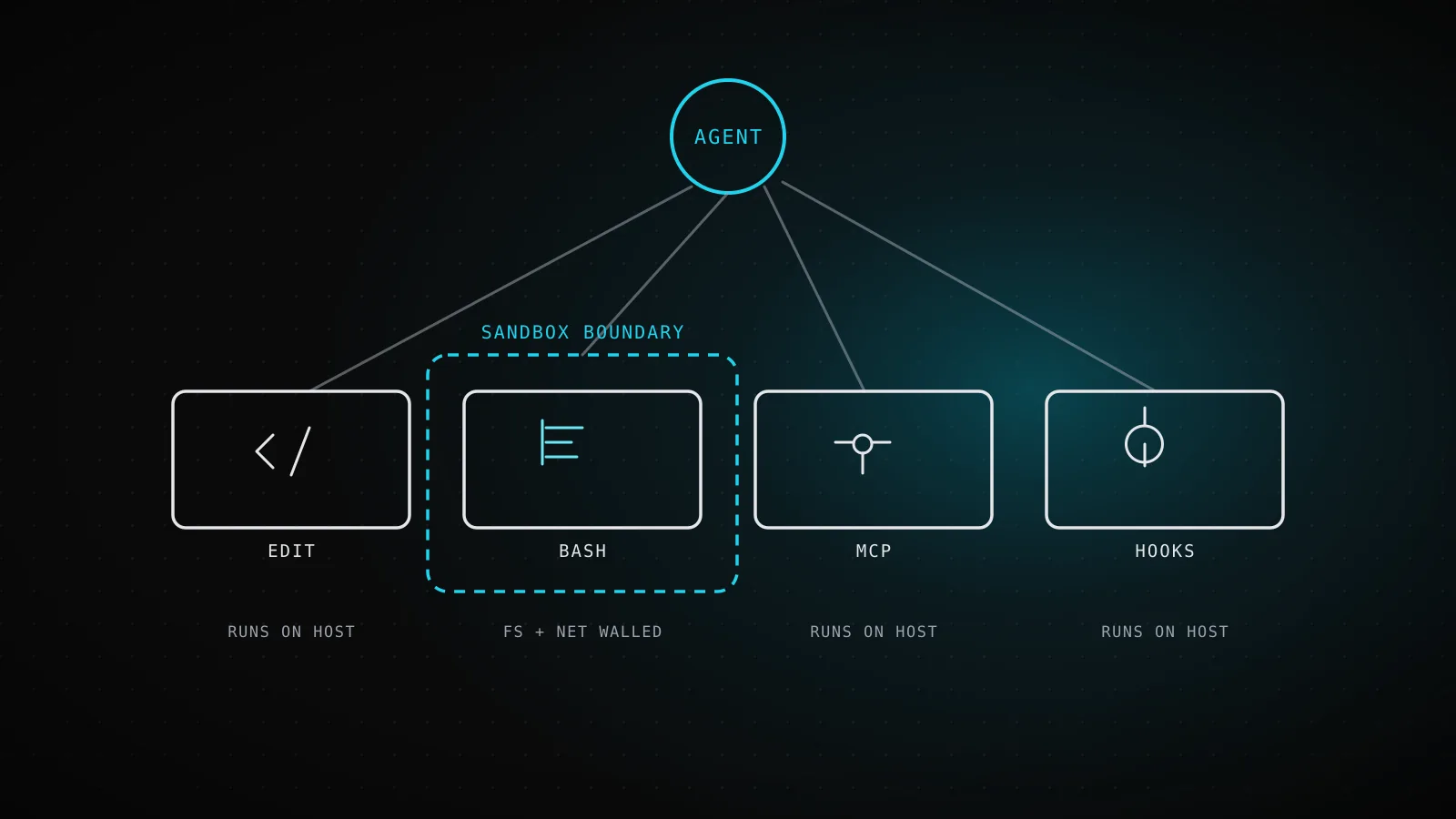
Claude Code's sandbox mode restricts what a Bash command can read, write, and reach on the network once it's running - nothing more. It does not restrict the Edit or Write tools, MCP servers, or hooks, all of which keep running straight on the host unless you wrap the whole process in a separate sandbox runtime. And even for the commands it does cover, the default read policy still lets a sandboxed command open ~/.aws/credentials and ~/.ssh/ - the docs are explicit that you have to deny those paths yourself.
TL;DR -
/sandboxturns on OS-level isolation for Bash commands only: Seatbelt on macOS, bubblewrap on Linux and WSL2. By default it can write to the working directory,--add-dirpaths, and the session temp dir, and can read almost anything on disk including credential files unless you addsandbox.credentialsordenyReadentries. Network access goes through a proxy that pre-allows nothing until a domain is approved once. A fixed list of config-loading paths -.claude/settings*,.mcp.json, shell startup files,.git/hooks- stays denied no matter whatallowWritesays. Read/Edit/Write tools, MCP servers, and hooks are outside the boundary entirely; only the separate@anthropic-ai/sandbox-runtimepackage wraps the full process. Tested on this repo's own GitHub Actions runner: neitherbubblewrapnorsocatis installed, and Ubuntu 24.04's AppArmor policy blocks bubblewrap's user namespaces by default - so the sandbox can't even start here without extra setup, which is exactly why this project's own unattended safety net is a PR-and-CI gate instead.
Turning it on, and the two modes it runs in
Run /sandbox inside a session and it opens a panel with a Mode tab, an Overrides tab, and a Config tab (plus a Dependencies tab on Linux if a package is missing). Mode picks between auto-allow, where sandboxed commands run without a prompt and only a command that can't be sandboxed - one needing a domain you haven't approved, say - falls through to the normal permission flow, and regular permissions, where every Bash command still stops for approval even though it's running inside the boundary. Selecting a mode writes it to .claude/settings.local.json for that project; setting sandbox.enabled: true in ~/.claude/settings.json turns it on everywhere.
Auto-allow doesn't override everything. Deny rules still apply, rm/rmdir against a critical path still prompts, and a content-scoped ask rule like Bash(git push *) still forces a stop even for a sandboxed command. When a command fails specifically because the sandbox blocked it - a path or host it doesn't have access to - Claude Code appends the exact violation to the error, and Claude may retry the same command with a dangerouslyDisableSandbox parameter that runs it unsandboxed instead, going through the regular permission flow from there. Setting allowUnsandboxedCommands: false (the panel calls this Strict sandbox mode) removes that retry path entirely: a command either runs sandboxed or it doesn't run.
Filesystem and network: what's walled off by default
Two independent layers, and the docs are explicit that both matter:
Inside the sandbox boundary
Bash commands
every shell command Claude runs, plus their child processes
Filesystem writes from those commands
walled to the working directory, --add-dir paths, and the session temp dir
Network calls those commands make
routed through the sandbox proxy and its domain allowlist
Still running straight on the host
Read, Edit, Write tools
run inside the Claude Code process itself - gated by permission rules, not the sandbox
MCP servers
separate processes; unconstrained on the host unless the whole session runs inside the sandbox runtime
Hooks
same as MCP servers - a PreToolUse or PostToolUse script runs on the host, not in the Bash boundary
Filesystem. Write access defaults to the working directory, anything added with --add-dir, and the session temp directory - trying to write ~/.bashrc or a system binary in /bin/ fails. Read access is the opposite default: the whole computer, minus a short deny list, which means a sandboxed command can still open your AWS credentials file or SSH keys unless you explicitly add them to sandbox.credentials.files or filesystem.denyRead. That's not a bug the docs are hiding - it's stated directly, because the sandbox's filesystem layer was built around write containment first, and read protection for secrets is something you opt into on top of it.
Network. A proxy sits outside the sandbox and pre-allows nothing. The first Bash command that needs a new domain triggers a prompt (or the auto-mode classifier, if that's on); approving it allows the host for the rest of the session, and "yes, don't ask again" writes a WebFetch(domain:...) rule that persists across sessions. sandbox.network.allowedDomains pre-approves domains up front so a scripted run never hits that prompt at all, and strictAllowlist flips a miss from "ask" to "deny" outright - the setting a headless pipeline actually wants, since there's nobody to answer the prompt.
The paths nothing can unlock, even with allowWrite
Inside whatever directory a sandboxed command can otherwise write to, Claude Code still refuses writes to the specific files it loads its own configuration and code from: the .claude settings files, .claude/skills, .claude/agents, .claude/commands, .claude/hooks, .mcp.json, shell startup files like .bashrc, and hooks/config inside .git. The reasoning in the docs is direct - a command that could edit those files could grant itself wider permissions or plant a hook that then runs unsandboxed the next session, which would make the whole boundary pointless. There's no allowWrite entry or Edit permission rule that reopens one of these; the only way to lift the block is sandbox.filesystem.disabled, which turns off filesystem isolation entirely, network layer included in scope but not in protection. Run /sandbox and open the Config tab to see the resolved list for your own machine, under "Denied within allowed."
Tested: the runner that builds this site's own guides can't start the sandbox at all
Rather than describe the Linux setup requirements secondhand, this build checked them against the exact GitHub Actions runner it's running on right now:
bubblewrap installed?
No
which bwrap - command not found, on this repo's own GitHub Actions runner
socat installed?
No
which socat - also not found; both are required for the Linux Bash sandbox
AppArmor userns restriction
1
kernel.apparmor_restrict_unprivileged_userns - blocks bubblewrap's sandbox on Ubuntu 24.04+ until a profile is added
Claude Code's own docs list bubblewrap and socat as required packages for the Bash sandbox on Linux and WSL2, and separately warn that Ubuntu 24.04's default AppArmor policy blocks bubblewrap from creating the user namespaces it needs unless you add a profile granting it that capability. This runner - a standard ubuntu-latest-class GitHub Actions image - has neither package installed and carries exactly that AppArmor restriction. If this project's own daily guide-builder tried to turn on /sandbox today, it would land on the Dependencies tab and stop, not the Mode tab. That's not a criticism of the sandbox; it's just the honest state of a stock CI image, and it's the reason DispatchSEO's own builder doesn't lean on it - see the comparison below.
What the sandbox was never built to stop
A few limits worth knowing before treating this as a hard security boundary, straight from the docs' own limitations section:
- It doesn't inspect encrypted traffic. The built-in proxy makes its allow/deny decision from the requested hostname, not the contents of the connection, so a compromised process can attempt domain fronting or similar tricks against a broadly-allowed domain like
github.com. The optionalnetwork.tlsTerminatesetting exists for credential masking, not general content filtering. - Environment variables pass through by default. A sandboxed Bash command inherits the parent process's environment, credentials included, unless you deny or mask specific variables under
sandbox.credentials. - It's Bash-only, full stop. Read, Edit, and Write tools use the ordinary permission system, not the sandbox; MCP servers and hooks are separate processes that run on the host with no isolation at all unless the entire session runs inside the
@anthropic-ai/sandbox-runtimepackage (a beta, at the time this was checked) or a container/VM. - Turning off filesystem isolation to widen access is a real foot-gun. With
filesystem.disabledset, a sandboxed command that's still auto-allowed can write files - a shell startup script, something on$PATH- that a later command then runs unsandboxed, letting one session quietly widen its own access for the next one.
None of that makes the sandbox useless - it does exactly what it says for the one thing it covers. It just isn't the whole boundary, which is the mistake worth naming plainly rather than discovering mid-incident.
Sandbox, permission prompts, and a CI gate - three boundaries, not one
- constrains
- Filesystem and network reach of Bash commands only
- gets past it
- Edit/Write tools, MCP servers, hooks - none of those run inside it
- constrains
- Whether a tool call runs at all, and whether you're asked first
- gets past it
- --dangerously-skip-permissions turns this layer off entirely
- constrains
- Whether a change ever reaches the main branch
- gets past it
- Nothing the agent does inside its own run - the gate sits after it
The docs' own advice for --dangerously-skip-permissions makes the layering explicit: that flag removes the permission-prompt boundary entirely, so it should only run inside something that provides an isolation boundary of its own - a container, a VM, or the sandbox runtime - because the Bash-only sandbox alone isn't sufficient once nothing is left to ask before a file tool, an MCP call, or a hook runs.
This project's own daily guide-builder skips the sandbox question by never needing an isolation boundary around the agent at all. It runs headless in GitHub Actions with --permission-mode bypassPermissions, but the safety property isn't "what can this process touch on the runner" - the runner is disposable and holds nothing sensitive beyond its own job. It's "can anything this process does reach production without a second, independent check": every write lands as a PR, never a push to main, and a set of hooks and CI checks has to pass green before seo-auto-merge.yml merges it. A compromised or simply wrong command inside that run can make a bad commit; it can't make a bad commit that ships, because the gate that stops it sits in GitHub's infrastructure, entirely outside the agent's own process - the same shape as the sandbox's OS-level enforcement, just moved up to the repository instead of the filesystem.
Reach for the Bash sandbox when the risk is a single session on a machine that also holds things you care about - your dotfiles, your SSH keys, a browser profile - and you want fewer permission prompts without opening every path on disk. Reach for a container, VM, or the sandbox runtime when the whole process needs to be inside a boundary, not just its Bash calls - running with --dangerously-skip-permissions, or against a repository you don't fully trust. Reach for a PR-and-CI gate, sandbox or not, the moment the run is scheduled and nobody's watching it happen in real time, because that's the layer that catches what got past everything upstream of it.
FAQ
Does the sandbox work on native Windows? No. It supports macOS, Linux, and WSL2 only; on a native Windows host, run Claude Code inside a WSL2 distribution instead.
If a sandboxed command needs a new file path, does it just fail?
It fails with the specific path or host it was denied, appended to the command's error output, so Claude can see exactly what was blocked. From there it can retry the same command unsandboxed via dangerouslyDisableSandbox (unless allowUnsandboxedCommands is set to false), which routes through the normal permission flow instead.
Is /sandbox the same thing as a permission mode?
No. Permission modes decide whether a tool call runs and whether you're asked first; the sandbox decides what a Bash command can reach once it's already running. Auto-allow mode inside the sandbox and Claude Code's separate auto mode (the classifier that replaces manual prompts) work independently and can be combined.
Does enabling the sandbox protect credentials in environment variables automatically?
No - sandboxed commands inherit the parent process's environment by default, secrets included. sandbox.credentials.envVars with mode: "deny" unsets a variable before a sandboxed command runs, or mode: "mask" swaps in a placeholder that only becomes real on requests to hosts you list, so a tool that needs the credential to authenticate still works without a sandboxed command ever seeing the real value.
Can I require the sandbox for every developer on a team?
Yes, through managed settings (an MDM-delivered file or Claude.ai's server-managed settings) rather than each person's local config - set sandbox.enabled: true alongside failIfUnavailable: true so Claude Code refuses to start rather than silently falling back to unsandboxed when a dependency is missing, which is exactly the state this guide found on its own CI runner.
What the sandbox actually buys you is narrow and real: fewer permission prompts for the commands it can cover, and an OS-level wall around what those commands touch. What it was never going to buy you is a reason to stop caring about everything running outside that one boundary - the file tools, the MCP servers, the hooks, and, for anything that ships without a human reading the diff first, whatever check runs after the agent's own process is done.