Claude Code environment variables: what a headless CI run actually needs set
10 min read
On this page
Claude Code's own reference documents more than sixty environment variables, but a headless CI run only ever needs a handful of them: one that authenticates without a browser, a couple that pin the model so a job doesn't ride whatever Anthropic ships as the default next, a few that cap how long a stuck command or a runaway output is allowed to run, and one variable Claude Code sets on the process itself the instant it spawns a subprocess. Which one wins when a variable and a settings.json key disagree isn't decided by file precedence at all - it's decided per pair, and getting that backwards is a common reason a workflow that behaves on a laptop goes quiet or wrong in Actions.
TL;DR - For a headless run, the variables worth knowing are:
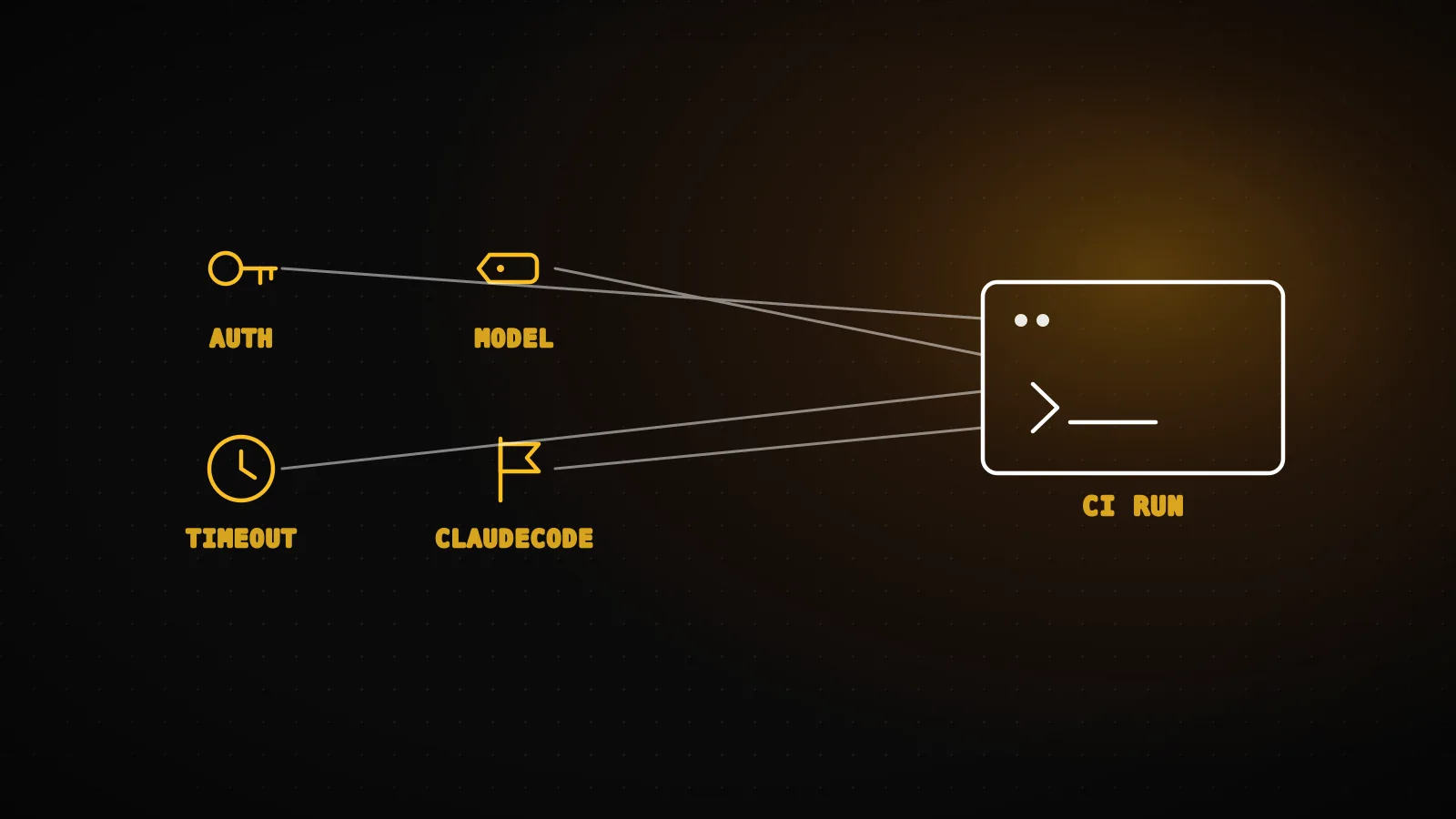
ANTHROPIC_API_KEY,ANTHROPIC_AUTH_TOKEN, orCLAUDE_CODE_OAUTH_TOKENfor auth (pick one);ANTHROPIC_MODEL/ANTHROPIC_DEFAULT_MODELto pin the model;API_TIMEOUT_MS,BASH_DEFAULT_TIMEOUT_MS,BASH_MAX_TIMEOUT_MS, andBASH_MAX_OUTPUT_LENGTHto keep a run from hanging or flooding its own log; andCLAUDECODE/CLAUDE_CODE_ENTRYPOINT, which Claude Code sets FOR you inside every subprocess it spawns. None of these are a level in the settings.json precedence stack - each wins or loses against its settings-file counterpart on its own rule, checked variable by variable.
Which wins when a variable and settings.json disagree
Claude Code's own settings documentation is direct about this: "environment variables aren't a level in this stack." A settings file's env block is an ordinary key that follows the usual five-level precedence - managed, command line, project-local, shared project, user - but a shell-exported variable sits outside that stack entirely, and whether it beats a settings file is decided per pair, not by rank.
The clearest example is the model. ANTHROPIC_MODEL exported in the shell overrides the model key from every settings file, every time, with no way for a committed .claude/settings.json to win that fight back. ANTHROPIC_DEFAULT_MODEL is the gentler sibling: it only fills in when no settings file sets model at all, so it never overrides a value someone deliberately committed. Telemetry works the other way in one specific sense: the export-style flags below don't take effect from a project or local settings file's env block except for a few off-values, so muting telemetry from a shared team file is more restricted than setting it directly in the shell.
That asymmetry is exactly why a workflow author needs to know which of these two families a given behavior belongs to before reaching for either file. Get it backwards - assuming a shared settings.json can always override a shell export, or that an export always overrides settings - and the fix that looks correct in review does nothing in the runner.
Authenticating a run that can't open a browser
A headless run has no browser to complete a device-code flow, which rules out one of Claude Code's four ways to authenticate outright:
| Method | How it's set | Billing | Works headless? |
|---|---|---|---|
| ANTHROPIC_API_KEY | Created at console.anthropic.com; sent as the X-Api-Key header | Metered - pay per token on the API account | Yes - drop it in as a CI secret, nothing else required |
| ANTHROPIC_AUTH_TOKEN | Set by hand, usually pointing at a proxy or gateway in front of the API | Sent as a Bearer Authorization header - billing depends on the gateway | Yes, once the gateway itself is reachable from the runner |
| CLAUDE_CODE_OAUTH_TOKEN | Minted once with claude setup-token (needs an active Claude subscription) | Rides the existing Pro/Max subscription instead of metered billing | Yes - this is what runs DispatchSEO's own daily guide-builder |
| Interactive OAuth login | claude auth login - a browser-based device flow tied to a human session | Same subscription as the token above | No - there's no browser in a runner to complete it |
CLAUDE_CODE_OAUTH_TOKEN is the one worth calling out by name: it's minted once, on a machine that does have a browser, with claude setup-token, and from then on it's a plain secret a runner can hold - no different in shape from an API key, but billed against a Pro or Max subscription instead of metered usage. It doesn't appear on Claude Code's own environment-variables reference page at all; it's documented instead through the setup-token CLI command and the anthropics/claude-code-action GitHub Action, which takes it as a direct input. DispatchSEO's own daily guide-builder - the workflow that produced this exact page - sets it as the primary credential and only falls back to ANTHROPIC_API_KEY when that secret is empty, specifically so that adding a metered key later can never silently switch a working subscription setup over to per-token billing.
One more var worth testing before trusting it: CLAUDE_CONFIG_DIR redirects where Claude Code writes its own config and session history. Setting it and re-running claude doctor against the new path produces a real .claude.json and a backups/ directory at exactly that location, nowhere else - confirmed while writing this guide, not assumed from the docs. That's the tool for a self-hosted runner that reuses the same box across concurrent jobs: point each job at its own CLAUDE_CONFIG_DIR and they stop competing for the same session-history file. A fresh GitHub-hosted runner doesn't need it - the whole container is disposable already.
The vars that make a run predictable: model, timeouts, output size
Beyond auth, three narrow families do almost all the useful work for CI:
Auth: exactly one var set, not zero
ANTHROPIC_API_KEY, ANTHROPIC_AUTH_TOKEN, or CLAUDE_CODE_OAUTH_TOKEN - once there's no browser to complete an interactive login, one of these three is the only way in.
Model pinned, not defaulted
ANTHROPIC_MODEL (or ANTHROPIC_DEFAULT_MODEL) set explicitly, or a scheduled job silently rides whatever Anthropic's own default becomes next.
A ceiling on every long-running command
BASH_DEFAULT_TIMEOUT_MS and BASH_MAX_TIMEOUT_MS set below the job's own timeout-minutes, so Claude Code kills a hanging command before the runner kills the whole job.
A ceiling on output, not just time
BASH_MAX_OUTPUT_LENGTH capped so one verbose command doesn't fill the run's log - and the model's context - with noise instead of signal.
Telemetry decided on purpose
DISABLE_TELEMETRY and DISABLE_ERROR_REPORTING set deliberately either way, rather than left to whatever the runner image happens to ship with.
ANTHROPIC_MODEL is the one to set explicitly rather than skip - a scheduled job that never pins it inherits whatever model Anthropic treats as current the next time the image or CLI updates, which is a quiet way for a pipeline's output quality or cost to shift on a day nobody touched the workflow file. The timeout and output vars matter for the opposite reason: they're the mechanism, not the symptom, behind a run that hangs mid-session - BASH_DEFAULT_TIMEOUT_MS defaults to 120000 (two minutes) before Claude Code kills a command on its own, BASH_MAX_TIMEOUT_MS caps how far the model itself can raise that ceiling (600000, ten minutes, by default), and BASH_MAX_OUTPUT_LENGTH caps how much of a command's output comes back at all (30000 characters by default, 150000 at the outside). None of the three replace a job-level timeout-minutes in the workflow file; they're what keeps one bad command from silently eating the whole budget before that outer timeout ever fires.
What this exact build's own environment actually had set
DispatchSEO's own builder is a live example, not a hypothetical one - here's what a env | grep CLAUDE inside this run's own shell actually returned while this guide was being written, next to what .github/workflows/seo-daily.yml sets on top of Claude Code's defaults:
env | grep CLAUDE, this exact build, plus seo-daily.yml's own env: block
Auth var used
OAUTH_TOKEN
CLAUDE_CODE_OAUTH_TOKEN first; ANTHROPIC_API_KEY only if that secret is empty
CLAUDECODE
1
set on this process the moment Claude Code spawned it - confirmed live
Entrypoint
github-action
CLAUDE_CODE_ENTRYPOINT names the action, not a bare CLI call
MCP_TIMEOUT
120000
this repo's own ceiling on MCP tool calls - not a Claude Code default
None of this is a mockup - it's what a env | grep CLAUDE inside this run's own Bash tool actually printed.
CLAUDECODE and CLAUDE_CODE_ENTRYPOINT aren't vars a workflow author sets - Claude Code writes them into every subprocess it spawns (Bash calls, hooks, MCP servers) so that anything running underneath can tell it's inside a Claude Code session rather than a bare terminal, and tell an action-triggered run apart from a bare CLI invocation. A hook or an MCP server that needs to behave differently under automation than it would for a person typing commands by hand can branch on CLAUDECODE being present rather than guessing from context. MCP_TIMEOUT is the opposite kind of fact: it's this repo's own addition, a ceiling this pipeline puts on its MCP tool calls that Claude Code doesn't set for you by default.
A GitHub Actions job that sets all of it correctly
A minimal job that authenticates, pins the model, and caps runtime and output - every value here traces to a variable covered above, not a new one:
jobs:
  build:
    runs-on: ubuntu-latest
    timeout-minutes: 30
    steps:
      - uses: actions/checkout@v4
      - run: npm install -g @anthropic-ai/claude-code
      - name: Run Claude Code
        env:
          CLAUDE_CODE_OAUTH_TOKEN: ${{ secrets.CLAUDE_CODE_OAUTH_TOKEN }}
          ANTHROPIC_MODEL: claude-sonnet-5
          BASH_DEFAULT_TIMEOUT_MS: "120000"
          BASH_MAX_TIMEOUT_MS: "300000"
          BASH_MAX_OUTPUT_LENGTH: "30000"
          DISABLE_TELEMETRY: "1"
        run: |
          claude -p "run the test suite and summarize any failures" \
            --permission-mode bypassPermissions \
            --max-turns 20
BASH_MAX_TIMEOUT_MS is set well under the job's own timeout-minutes: 30, on purpose - it's what makes Claude Code's own kill switch fire first, so the failure this job reports is "a command timed out" instead of the far less useful "the whole job timed out" from GitHub itself. --permission-mode bypassPermissions still has to be a CLI flag rather than a settings key, for the reason covered in the settings.json breakdown: that one mode can't be granted from a committed file at all. This job runs claude directly rather than through anthropics/claude-code-action; the scheduled-pattern guide covers that action-based shape and the trigger/concurrency setup around it.
The failure that only shows up in CI: set locally, missing from secrets
The most common way this goes wrong has nothing to do with which variable to pick - it's that a variable working perfectly on a laptop was never anything but a line in ~/.zshrc or ~/.bash_profile, and a GitHub Actions runner starts from a clean image that has never read either file. ANTHROPIC_MODEL set that way, or an API key exported once and forgotten, works every time locally and fails - or worse, silently falls back to a different model or auth path - the first time the same command runs in CI. The fix is mechanical but easy to skip under deadline pressure: every variable a workflow's env: block needs has to exist as a repository or organization secret, referenced explicitly with ${{ secrets.NAME }}, because nothing on the runner will ever pick it up from a developer's shell.
A cheap preflight catches this before the real job wastes a run on it:
for v in CLAUDE_CODE_OAUTH_TOKEN ANTHROPIC_API_KEY ANTHROPIC_MODEL; do
  [ -n "${!v}" ] && echo "$v: set" || echo "$v: MISSING"
done
Run that as the first step of the job and a missing secret shows up as one clear line in the log, instead of an auth failure or a wrong-model run twenty minutes into a job that could have failed in the first second.
When environment variables are the wrong tool
Not everything belongs here. Team policy that needs to be reviewable in a diff - permissions.allow and permissions.deny rules, hooks, which MCP servers a project trusts - belongs in a committed settings.json, not an environment variable buried in a workflow file that changes behavior without anyone seeing it move. And exactly one permission mode, bypassPermissions, can't be reached through an environment variable at all, any more than it can through a committed settings file - it's a session-scoped CLI flag by design, because the mode that skips every check is the one mode that shouldn't be settable from something that persists.
FAQ
Does Claude Code read a project's .env file automatically?
No. Claude Code doesn't source a repo's .env file for its own configuration - a variable has to be exported into the process's actual environment (the shell, or a workflow's env: block) or set under a settings file's env key to take effect.
If I set ANTHROPIC_MODEL and also pass --model on the command line, which one runs?
--model wins. Per Claude Code's own reference, ANTHROPIC_MODEL is overridden by both the --model flag and the /model command - the flag is scoped to that one invocation and always takes precedence over the environment.
Can I put ANTHROPIC_API_KEY directly in the workflow YAML instead of a secret?
Don't. A literal key in a committed file is a leaked credential the moment that file is pushed, public repo or not. Store it as a repository or organization secret and reference it with ${{ secrets.ANTHROPIC_API_KEY }}.
Does CLAUDE_CODE_OAUTH_TOKEN expire?
It's built to be long-lived, but it's tied to the subscription that minted it - if that subscription lapses or the token is regenerated elsewhere, authentication fails outright in CI unless the workflow also sets an ANTHROPIC_API_KEY fallback, the same pattern DispatchSEO's own builder uses.
Do I need to set CLAUDE_CONFIG_DIR in CI?
Usually not. A GitHub-hosted runner starts from a clean, disposable container, so there's nothing for a redirected config directory to avoid colliding with. It earns its place on a self-hosted runner that reuses the same box across concurrent jobs.
Anthropic's own reference is the right place to look up a variable you already suspect exists. What it doesn't do is tell a workflow author which handful of its sixty-plus rows actually change behavior for a scheduled, unattended run - that's a question about CI, not about the CLI, and it has a much shorter answer than the reference page implies.