Ubersuggest alternative: past the point where one dashboard is enough
6 min read
On this page
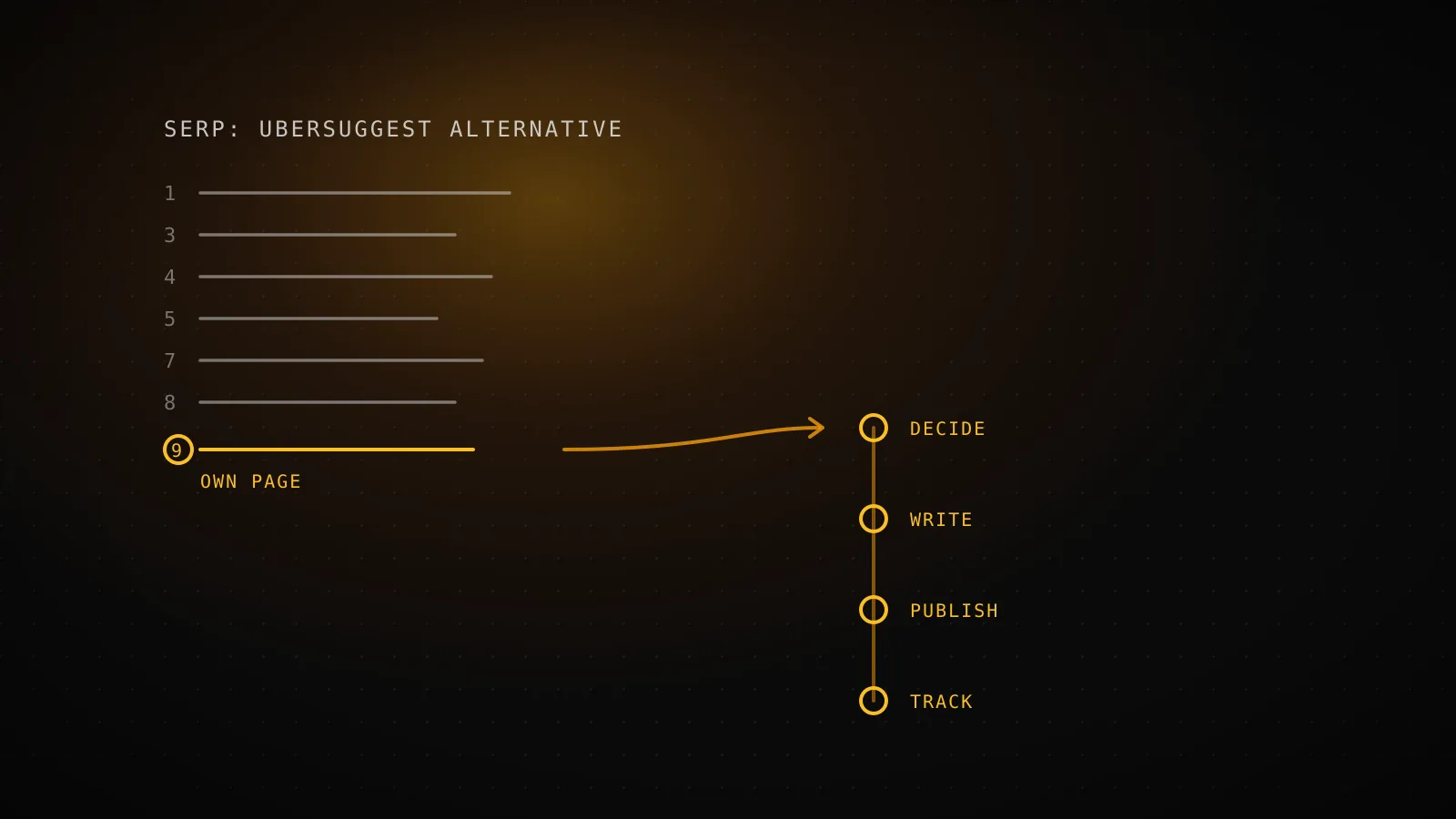
Ubersuggest's own homepage doesn't hold the top spot for the phrase "ubersuggest alternative" - a rival keyword tool's dedicated landing page does, and Ubersuggest itself shows up ninth, confirmed with a live SERP pull for this guide. That's the honest answer to what the phrase is really asking: not "where's a cheaper keyword-idea tool," but "what handles everything after the list." DispatchSEO is built for that handoff - Ubersuggest was never trying to close it in the first place.
TL;DR - Ubersuggest's own homepage ranks 9th for "ubersuggest alternative," confirmed with a live SERP pull for this guide: a rival keyword tool's dedicated page, three listicles, and two competing all-in-one SaaS tools all outrank it. This project's own DataForSEO account shows why the search itself is winnable - KD 9 on 110 searches a month for this exact target, against KD 81 on the obvious broad seed "keyword research tool," a term a DR-5 site like dispatchseo.com (6 referring domains, 96 backlinks) has no real path to yet. The people typing this query already know how to find a keyword; the gap is everything after that - deciding, writing, publishing, tracking - without opening a second dashboard for any of it.
the on-ramp job it still does
Ubersuggest earns its spot for what it's actually built for: cheap keyword ideas and a rough SERP read for someone who hasn't done this before. Type a seed, get volume and a difficulty score back, see who's already ranking - no setup, a free tier that doesn't require a card, and a UI built not to intimidate a first-time user. For a solo operator picking their very first ten keywords, that's a real job done well.
the manual chain after the list
The list is where Ubersuggest's job ends. Everything after it is still manual: deciding which of those ten keywords this specific site can actually win, not just which one has a big enough number next to it; writing the page; publishing it somewhere; checking a few weeks later whether it moved; and doing all of that again next week. A beginner doesn't feel that gap yet - they're still learning what a keyword even is. Someone searching "ubersuggest alternative" usually isn't a beginner anymore; they've run the list enough times to feel every step after it.
who's actually competing for this search
| Pos | Domain | What's there | Result |
|---|---|---|---|
| 1 | keywordtool.io | Competing keyword tool | "Ubersuggest Alternative - Better Keywords, Faster" |
| 3 | blog.answersocrates.com | Roundup listicle | "Top 10 Ubersuggest Alternatives in 2025 (Free & Paid)" |
| 4 | sitechecker.pro | Competing all-in-one SaaS | "Ubersuggest Alternative for Agencies with White Label" |
| 5 | seo.com | SEO media brand | "12 Ubersuggest Alternatives To Consider for 2026" |
| 7 | outsourceaccelerator.com | Roundup listicle | "Top 10 SEO software to use as an Ubersuggest alternative" |
| 8 | morningscore.io | Competing all-in-one SaaS | "Simple all-in-one SEO tool | Ubersuggest alternative" |
| 9 | app.neilpatel.com | Ubersuggest's own page | Ubersuggest's own homepage |
| 10 | youtube.com | Video review | "Ubersuggest Review - Keyword Research, AI Writer, and ..." |
Eight results, checked live: one direct competitor's dedicated landing page, three listicles, two competing all-in-one SaaS tools, one SEO media brand, and Ubersuggest's own homepage at position 9 - fourth from the bottom of its own branded query.
Read the field and a pattern shows up fast: this isn't reviewers weighing in, it's other tools selling themselves into the same query. A direct competitor bought the top spot with a page built for exactly this search. Two more vendors did the same lower down. Three listicles round up a dozen tools apiece without scoring any of them against a specific site. And Ubersuggest's own homepage - the thing someone typing this query might actually want to double-check - sits fourth from the bottom of its own branded search.
the gap this account's own numbers show
"ubersuggest alternative" (this guide's target)
KD 9
110 searches/mo - clears this project's auto-approve line outright
"keyword research tool" (the obvious broad seed)
KD 81
5,400/mo - pulled from the same account, and what a young site has no path to yet
dispatchseo.com's own authority
DR 5
6 referring domains, 96 backlinks - the real ceiling a KD-81 term runs into
Both figures came from the same DataForSEO account, billed to this project, pulled the same session. The obvious move for a new keyword-research pass is to reach for the broad category term - "keyword research tool" - and it comes back at KD 81 on 5,400 searches a month: nowhere a 5-week-old, DR-5 domain is going to rank. This exact page's own target sits at KD 9 on 110 searches a month, low enough to clear this project's auto-approve line the moment a live SERP check confirmed the field was mostly other tools' marketing pages, not entrenched authority sites. A keyword tool that hands back volume and difficulty for both terms with equal confidence isn't wrong - it's just stopping one decision short of which of the two is actually worth building.
two chains, one stops at the list
Seed keyword typed in
"ubersuggest alternative", or whatever the site is chasing
Ubersuggest
Keyword ideas + rough SERP data returned
A list, with volume and a difficulty score attached
Waits for a person
Nothing decides, writes, publishes, or tracks until someone opens the list
DispatchSEO
Ideas expanded the same way
keyword_ideas / suggest_keywords, same kind of raw data
Live SERP gate filters what's winnable
Re-checked against this site's own current authority before a word is written
PR opened, merge-ready
Drafted, visualized, humanized - the owner reviews the page, not the idea
Rank tracked after merge
Nightly check picks up where the build left off
Ubersuggest's chain and DispatchSEO's chain start at the same place - a seed keyword - because expanding a seed into ideas is a solved problem neither one is trying to reinvent. keyword_ideas and suggest_keywords do that same first step here. What happens to the output is the actual difference: Ubersuggest hands back a list and stops, and nothing moves again until a person opens it. DispatchSEO's own research-to-PR loop runs a live SERP gate against the output before a word gets written, drafts the page, ships the visuals and a humanizer pass, opens a pull request, and keeps tracking the keyword's rank after it merges - one pipeline, not four separate manual steps between the same two endpoints.
who should stay on the on-ramp
Someone still learning what search volume and difficulty even mean, or brainstorming across a dozen unrelated niches in one sitting, is better served by a tool built for exactly that kind of open-ended browsing - Ubersuggest does that job well, and so does a bundled suite like Mangools for the same audience. The switch to a closed loop makes sense once the bottleneck moves: once picking the keyword stops being the hard part and shipping the page consistently becomes the hard part, a list generator is the wrong tool for the job it's still being asked to do.
when not to use this
DispatchSEO isn't a free Ubersuggest. It needs its own DataForSEO account (billed to whoever runs the project) and a coding agent already working inside a repo - standing one up just to avoid a keyword-tool subscription costs more setup time than it saves. If the job really is open-ended keyword brainstorming across clients or niches with no single site's content queue behind it, Ubersuggest's dashboard is still the faster tool to open. For a single gut-check on a keyword list already in hand, no login required, the free keyword clustering tool runs one slice of this same pipeline in the browser.
faq
Where does Ubersuggest's own homepage rank for "ubersuggest alternative"? 9th, per a live check pulled for this guide - behind a rival keyword tool's dedicated landing page, three listicles, and two competing all-in-one SaaS tools.
Is "ubersuggest alternative" actually a winnable search? For a young site, yes at KD 9 on 110 searches a month - this project's own DataForSEO pull confirms it, well under the auto-approve line, and far below the KD 81 the obvious broad seed "keyword research tool" carries on the same account.
Does DispatchSEO replace Ubersuggest's keyword research?
For one project's own keyword expansion, yes - keyword_ideas and suggest_keywords cover that same step. It isn't a general-purpose, type-a-seed browsing tool for exploring unrelated niches or client accounts; Ubersuggest still does that job better.
What does DispatchSEO do that Ubersuggest doesn't? Everything after the list: a live SERP gate that decides whether a keyword is actually winnable, a written and visualized page, a merge-ready pull request, and rank tracking afterward - one pipeline instead of a list handed back to a person.
Do I need a coding agent already running to use this? Yes. DispatchSEO is MCP tools and crons an agent drives inside a repo - without one already in place, this is a bigger project to take on than swapping keyword tools, not a lighter one.
Ubersuggest ranking ninth for its own alternative query isn't a scandal - it's what happens when a search is really asking "what comes after the list," and a keyword tool's homepage was never built to answer that. The question worth sitting with is whether picking a keyword and then deciding, writing, publishing, and tracking it by hand is still the workflow worth keeping, whichever tool hands you the first step.