Outrank alternative: the open-source, self-hosted version of the same idea
7 min read
On this page
DispatchSEO's own readme calls it "an open-source alternative to SEObot and Outrank" - so if you searched outrank alternative, the honest answer is sitting in this project's own positioning, not in a listicle. Outrank is a hosted SaaS that researches, drafts, and auto-publishes 30 to 90 SEO articles a month starting at $99/mo, plus AI images and a backlink-exchange network, verified live on outrank.so's own pricing page. DispatchSEO runs the same underlying job - research a gap, draft it, publish it, keep tracking it - through your own coding agent instead of Outrank's, and lands as a pull request in your own repo instead of an auto-published page inside Outrank's system.
TL;DR - Outrank is a $99/mo all-in-one SaaS: automated keyword research, AI-drafted articles auto-published through WordPress/Webflow/Shopify/Notion and other integrations, AI images, and a backlink-exchange network, with add-ons up to $259/mo for 90 articles a month. DispatchSEO does the same research-to-published-page job, but through the coding agent you already run (Claude Code, Codex, or Cursor), and it stops one step earlier - at a pull request with a deploy preview, not an auto-publish. Self-hosted it's $0 software; hosted, it's convenience pricing on top of the same idea. Neither model is strictly better: Outrank buys packaged breadth (150+ languages, a built backlink marketplace, human editors on request); DispatchSEO buys a review gate and no vendor lock-in.
What $99 a month actually buys on Outrank
Outrank's pitch is "Grow Organic Traffic on Auto-Pilot": it explores your niche and competitors to build a 30-day content plan, then produces SEO-optimized articles from that plan every day, in 150+ languages, with AI-generated images auto-inserted as both in-body visuals and featured images. A chat interface lets you brainstorm keywords and pull live search data, and the platform flags underperforming published articles for a rewrite. Publishing goes out through direct integrations - WordPress, Webflow, Shopify, Framer, Wix, Notion, Ghost, WordPress.com, or a custom webhook - with nothing sitting between "article generated" and "article live."
| Plan | Output | Price | What's included |
|---|---|---|---|
| Outrank All-in-One | 30 articles/mo, auto-published | $99/mo | Keyword research, AI images, backlink exchange, and every publishing integration included. |
| Outrank + 90-article add-on | 90 articles/mo (3/day), auto-published | $259/mo | $99 base plus the $160/mo add-on. Human-curated editing is a separate $1,399/mo tier on top of that. |
| DispatchSEO, this project | 1 guide/day cap, each one a PR | $0 software | Hosting plus the DataForSEO usage and coding-agent subscription you already pay for - no seat, no article ceiling to buy against. |
Outrank prices by publishing volume - more articles a month means a bigger add-on stack. DispatchSEO caps at one guide a day on purpose (see the pacing note further down) and prices by usage instead of output.
The All-in-One plan is $99/mo (or $999/year, saving $189) for 30 articles a month, automated keyword research, backlink exchange access, AI images, unlimited users, and every publishing integration. Volume add-ons stack on top: $85/mo more for 60 articles, $160/mo more for 90. Past that, Outrank sells a menu of extras - a $1,399/mo human-curated editing pass, $199/mo or $899/mo backlink-credit tiers, a $199/mo weekly auto-built interactive tool, a $49/mo premium image model, and a $500 one-time directory-submission service - plus 10-20% volume discounts for agencies running multiple sites.
The readme's other half: your agent, not a subscription
The other side of that comparison is DispatchSEO's actual shape: one backend that exposes an MCP server, and your own coding agent is what drives it - researching keywords, drafting guides, watching rankings and Search Console, all through tool calls the agent makes inside a session it's already running. Nothing here is a black-box model writing about your product with no context on your codebase or your voice; it's the same agent that already knows your repo, pointed at your marketing site instead of your app. The backend itself is self-hosted - a single Vercel deployment plus Supabase, $0 in software cost - or run hosted for convenience if standing up your own instance isn't the point.
The publish moment, forked two ways
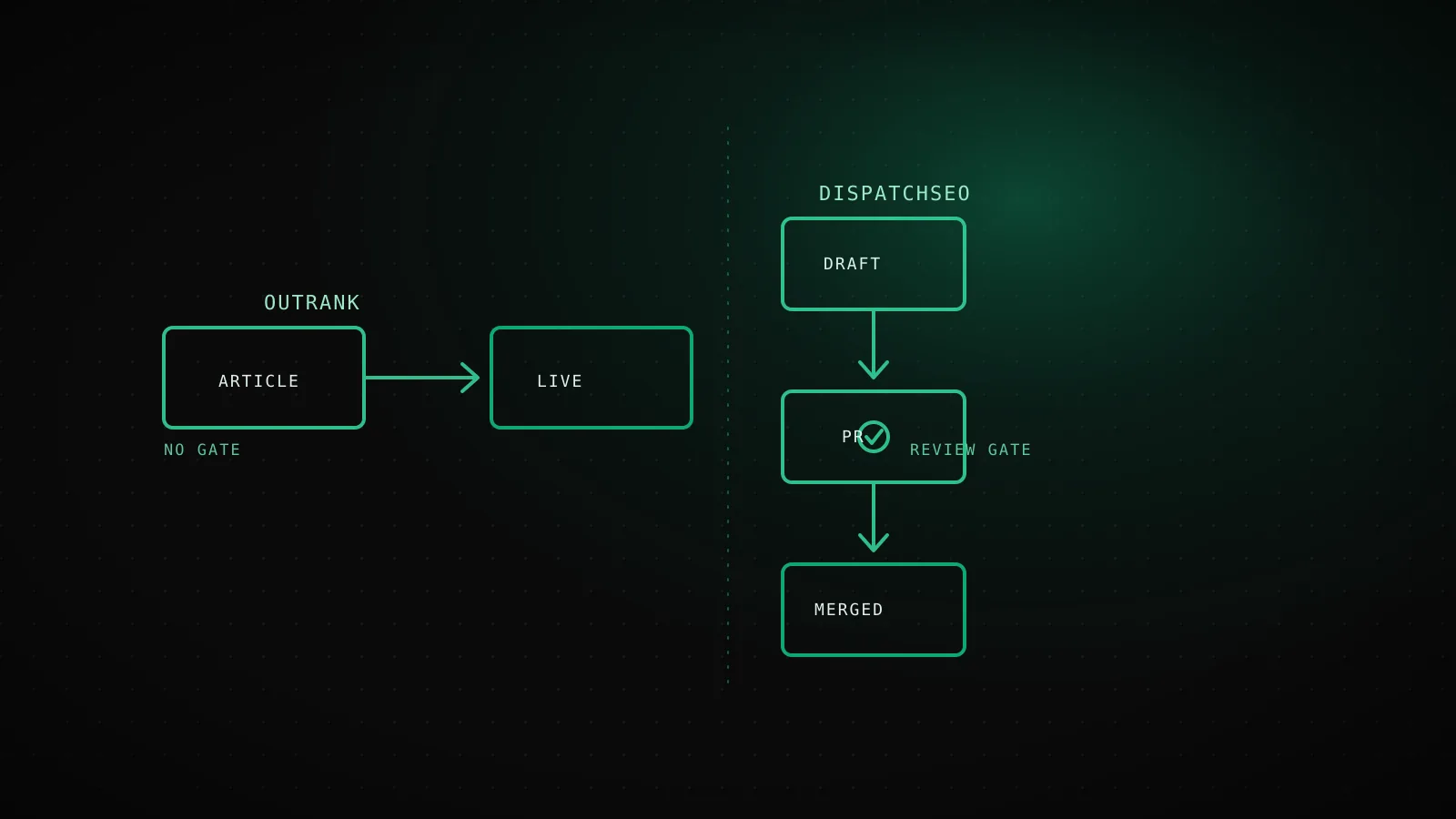
Both engines start from the same job - find a gap, draft a page, get it live, watch whether it ranks - and the fork happens at the exact moment a draft is finished.
Outrank's engine - runs to publish
Niche + competitor plan generated
Outrank explores keywords and builds a 30-day content plan
Article drafted and imaged automatically
AI writes it, AI-generated images auto-insert
Auto-published through an integration
WordPress, Webflow, Shopify, Notion, or a webhook - no review gate
Backlink exchange runs in the background
AI adds links to your site inside partner articles, and back
DispatchSEO's engine - runs to a PR
Suggestion queued, SERP-gated
Only proposed if the draft can genuinely beat page 1
Your own agent drafts it
Claude Code, Codex, or Cursor - whichever already knows your repo
PR opened with a deploy preview
Nothing ships until the preview link is checked
You click merge
The one step Outrank's engine skips entirely
Outrank's chain doesn't pause there: the article goes straight out through whichever integration you connected, live on your site with no gate in between. DispatchSEO's chain adds one more step on purpose - the draft becomes a pull request with a deploy preview, and nothing merges until a person looks at it. That gate is also where the thin-content and live-SERP checks this exact guide went through happen: a draft that can't beat what's already on page 1 gets held back instead of shipped, which auto-publish has no equivalent step for.
The unglamorous numbers this run can actually show
Every guide this project ships gets checked against its own real state instead of a projected pitch - this page's numbers, pulled by the same run that wrote it, are no exception.
"outrank alternative" itself
Not yet ranked
Queued the day this idea was approved - first check outside the top 100
Guide pace, this account
1/day cap
7 shipped in the last 7 days - a PR each, never an auto-publish
GSC feed, 28 days
9,559 impr.
4 clicks - a 35-day-old domain, before click-through catches up
"Outrank alternative" was added to this project's own keyword tracker the day this idea was approved, before a word of this draft existed - its first check landed outside the top 100, which is simply where any page starts before it's had time to earn a position. The guide cadence is capped at one a day on purpose: seven shipped in the last seven days, each one a reviewed PR, never an auto-publish batch. And the Search Console feed for the whole domain, 28 days in: 9,559 impressions against 4 clicks - small numbers a 35-day-old domain would show no matter which engine wrote the pages.
When Outrank is still the smarter pick
Outrank's packaged breadth is real and DispatchSEO doesn't try to match all of it. If you want content in 150+ languages out of the box, a built backlink-exchange marketplace instead of finding link partners yourself, or a $1,399/mo human-editor pass so nobody on your team ever opens a diff, Outrank has already built that and DispatchSEO hasn't. It also fits teams with no repo and no interest in one - "review a pull request" is a feature if you already work that way, and friction if you don't. DispatchSEO's honest tradeoff runs the other direction: it needs its own DataForSEO account and a coding agent already working inside your repo, and self-hosting means you're the one keeping the Vercel deployment alive, not a vendor's support line.
Outrank and DispatchSEO are chasing the same reader - someone who wants SEO content to happen without doing the research and drafting by hand - through genuinely different models, not a cheaper knockoff of the same one. Auto-publish buys speed and packaged breadth; a PR buys a review gate and a repo you own outright. Which one's right depends on whether "nothing ships without you looking at it first" sounds like a feature or a chore.
FAQ
What does Outrank cost? $99/mo (or $999/year) for the All-in-One plan: 30 articles a month, automated keyword research, backlink exchange access, AI images, unlimited users, and every publishing integration, verified live on outrank.so/pricing. Volume add-ons run $85/mo more for 60 articles a month or $160/mo more for 90.
Does DispatchSEO auto-publish content the way Outrank does? No, and this guide doesn't pretend otherwise. Outrank pushes a finished article straight through a connected integration with no gate. DispatchSEO stops at a pull request with a deploy preview - a person merges it, every time.
Does DispatchSEO have anything like Outrank's backlink exchange? Not a marketplace of partner sites trading links automatically. DispatchSEO tracks backlink prospects for its own outreach queue, which is a narrower job than an automated exchange network - if a built-in link marketplace is what you're after, Outrank's is already running.
Which coding agents does DispatchSEO work with? Claude Code, Codex, and Cursor are all first-class - whichever one already runs in your repo drives the MCP tools this project exposes.
Is DispatchSEO actually free, unlike Outrank's $99/mo floor? The software is $0 self-hosted - the real costs are the DataForSEO account behind keyword research and rank tracking (billed to whoever runs the project) and the coding-agent subscription you're probably already paying for. A hosted option exists for convenience if standing up your own instance isn't the point.
Does this exact page rank for "outrank alternative" yet? Not yet, and this guide says so plainly rather than skip past it: the keyword was added to this project's own tracker the day the idea was approved, and its first check came back outside the top 100 - the ordinary state of anything this new.
Neither product is chasing the same buyer with a different sticker price - one is a subscription you configure and let run, the other is a workflow bolted onto an agent you already trust with your code. If you've read this far weighing the two, that choice is probably already made; the free clustering pass in DispatchSEO's own keyword tool is a no-signup way to see the research half of that workflow before deciding.