AI-powered SEO tools compared: assistants that suggest vs agents that ship
9 min read
On this page
Type "ai powered seo tool" into Google and the top results already agree on one thing without saying it out loud: every SEO tool sold this year claims to be AI-powered, so the label quit doing any filtering work. Pull the actual product pages behind those results and a real filter shows up on its own - not whether a tool uses AI, but what happens the instant it finishes a draft: does the work stay in an editor for a person to act on, does it go live on your own site with review turned off by default, or does it stop at something a person still has to approve. That split, checked live on three vendors' own current homepages while writing this, is what the rest of this guide sorts by.
TL;DR - "AI-powered SEO tool" spans three genuinely different tiers, not one: assist tools (Surfer, Clearscope, MarketMuse) that hand back a score or a brief and stop there; autonomous-publish agents (SEO.AI, Outrank) whose default path pushes a finished article live with review as an opt-in extra, not a requirement; and reviewed-pipeline agents, DispatchSEO's own shape, where a draft stops at a pull request until a person merges it. Checked live on each vendor's own site while writing this: SEO.AI's homepage says "new articles go live automatically," Outrank's says the same with an optional preview step, and Surfer's has no publish integration at all. This guide's own numbers, pulled the same way: DR 8, a 0% AI-citation rate across 171 checks, and 5 clicks against 1,641 impressions over the last 28 days.
The filter none of today's page 1 sorts by
Pull the live results for "ai powered seo tool" and four of the eight organic listings are roundup posts - "17 Best AI SEO Tools," "We Tested the 14 Best," "I Tried 18 AI SEO Tools," and a fourth for content-optimization tools specifically - stacking whichever tools each author has personally used, alongside one Reddit thread asking the same question and three vendor pages, seo.ai's own homepage among them. Every name on every one of those lists gets called "AI-powered," and every one has earned that label technically, which is exactly the problem: it groups a tool that scores your draft's keyword density in the same sentence as a tool that publishes 90 articles a month to your live site without you touching it. None of those roundups sort by that gap - they sort by which tools the author happened to try, which is a different and much less useful question than what a tool actually does once it's done thinking.
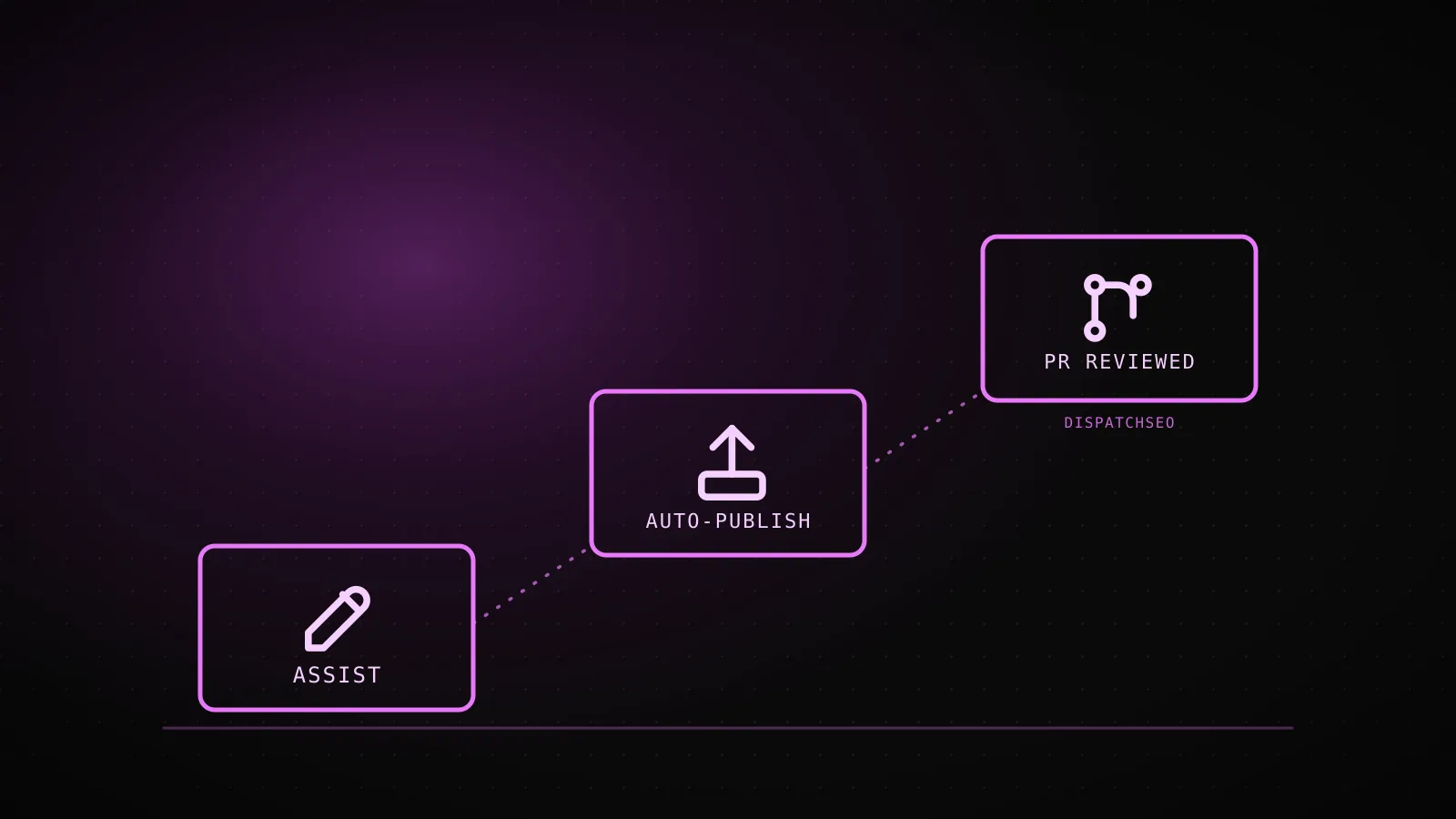
Three tiers, checked on each vendor's own current homepage
Tier 1 - assist
Stays in the vendor's own editor
Surfer, Clearscope, MarketMuse: a score, a brief, or a draft you paste out yourself.
Tier 2 - autonomous, review optional
Goes live on your site by default
SEO.AI, Outrank: articles publish automatically unless you turn review on yourself.
Tier 3 - reviewed pipeline
Stops at a pull request
DispatchSEO's own shape: nothing merges until a person looks at the diff.
The tier a tool sits on has nothing to do with how good its AI is - it's about where the handoff to a person happens, if it happens at all. Fetched live from surferseo.com, seo.ai, and outrank.so during the session that wrote this, not paraphrased from another roundup's summary of them:
| Product | Tier | What ships without a person | From its own site, checked live |
|---|---|---|---|
| Surfer | Assist | Nothing - content stays in Surfer's own editor until you export it | Markets itself around a Content Editor, AI Outline, and an AI Tracker; no publishing integration listed on its homepage. |
| SEO.AI | Autonomous, review optional | Full articles - auto-publish is the default path | "New articles go live automatically. No coordination. No manual uploads." |
| Outrank | Autonomous, review optional | Full articles pushed through a connected CMS integration | "We create and publish SEO-optimized articles from your plan every day. Your blog grows automatically." (a review step exists, but it’s opt-in.) |
| DispatchSEO | Reviewed pipeline | Nothing - every draft stops at a pull request | This guide itself: drafted by an agent, opened as a PR, merged by a person before it went live. |
Surfer's homepage lists a Content Editor, an AI Outline generator, and an AI Tracker that watches mentions across ChatGPT and Google AI Overviews - real capability, and none of it leaves Surfer's own interface. SEO.AI's copy is the most direct of the three: "SEO.AI is the AI SEO agent that creates ranking content, publishes it to your website, builds relevant backlinks," with review available but not required. Outrank's default is the same shape with one more knob - "Pre-create any scheduled article up to 7 days ahead. Review it, edit it, approve it - then let it auto-publish on its day" - which means the review step is something you have to remember to use, not something the system waits for.
Tier one: assist tools that never leave their own editor
Surfer, Clearscope, and MarketMuse are the clearest examples of this tier, and none of them hide it. MarketMuse's own homepage states outright that it doesn't write content for customers - its generative-AI component helps a person draft faster inside its interface, full stop. Clearscope and Surfer both build their pitch around a content-editor score you improve against, not a publish button. The job these tools do is real and often underrated: a term-coverage score built from what's already ranking is a genuinely useful check before you hit publish anywhere. The job they don't do is finish anything - a person still writes the sentences, still copies them into a CMS, and still clicks the button that puts them live.
Tier two: agents that go live with review as an afterthought
SEO.AI and Outrank both close the loop that tier one leaves open - research, draft, and publish all happen inside one system, with no separate editor to paste into. The distinction worth noticing, because none of today's page 1 draws it, is that "review optional" and "review required" are not the same safety property wearing different words. A tool where publishing is the default and checking is the extra step will publish an ungated draft the one time you forget to look, because forgetting is the normal case a system without a gate has to survive and doesn't. Outrank's own pricing tier structure charges by article volume - 30 to 90 articles a month - which is a pace built assuming most of them never get a second look before they're live.
Tier three: the pipeline none of page 1 names
DispatchSEO runs the same research-to-published-page job as tier two, with one deliberate difference: the draft stops at a pull request, and nothing about that step is optional. An agent already reasoning about your codebase does the keyword research, writes the draft, builds the visuals, and opens the PR - the review gate isn't a checkbox left off by default, it's the point where a person's judgment is the thing that decides whether a page goes live, every single time. This exact guide is the demonstration: proposed by a research run, gated behind a live SERP check that had to show it could beat page 1, and it still isn't live until someone merges the PR it shipped as.
This site's own DR-equivalent
8
12 referring domains, 173 backlinks, spam score 2
AI-citation rate, all engines
0%
0 of 171 checks cited, across ChatGPT, Claude, and Google AI Overview
Search Console, last 28 days
5 clicks
1,641 impressions - the normal cold-start curve for a two-month-old domain
A DR of 8 and a 0% AI-citation rate aren't a pitch - they're what a young, review-gated domain actually looks like two months in, reported the same unflattering way every guide on this site reports its own numbers. Nothing about requiring review made those numbers better or worse; what it changes is which pages exist to be measured in the first place.
Why "review optional" is the wrong default once a draft can ship on its own
A term-coverage score being wrong costs you nothing - you read it, you disagree, you move on. A fully-drafted article going live on your domain because nobody happened to open the review screen that day costs you a page with your name on it that you didn't actually check, and SEO tools that generate full drafts are exactly the class where that failure is easiest to hit by doing nothing. The honest fix isn't "use AI less" - tier one and tier two both produce genuinely useful drafts - it's making the review step something the system waits on instead of something it offers. A gate you can skip isn't a gate for the one day you're moving fast and skip it anyway, and content is a bad place to find that out after the fact.
Picking one for your situation
A person on your team writing drafts either way, who wants a score to write against - Surfer, Clearscope, or MarketMuse fits, and none of them ask you to trust a system with your voice unsupervised. Wanting volume - 30, 60, 90 articles a month - more than you want a person checking each one first, and comfortable relying on yourself to actually use the optional review step - SEO.AI or Outrank does that job; Outrank's own pricing page lists $99-259/mo depending on volume, and SEO.AI's pricing sits behind its own /pricing page rather than its homepage. Already running a coding agent in your own repo, and "nothing ships without a merge" reads as a feature rather than friction - that's the reviewed-pipeline tier this guide's own pipeline sits in, and it's the wrong fit for a non-technical team with no repo, since a pull request isn't a workflow you can hand someone who's never opened one. Whichever tier you land on, the research step underneath all three looks the same - a free keyword clustering pass checks for overlap before any of them starts writing, no signup or tier required.
FAQ
Is every "AI-powered SEO tool" actually using AI in a meaningful way? Mostly yes on the "uses AI" question, which is exactly why it stopped being useful as a filter - the real difference is what happens after the AI finishes, not whether AI was involved at all.
Do SEO.AI and Outrank publish content without any human ever seeing it? Not necessarily, but by default, yes for the articles nobody manually intervenes on. Both offer a review or preview step; neither one makes it mandatory, so an unattended plan runs unreviewed unless someone actively opts into checking it.
Does DispatchSEO ever auto-publish the way SEO.AI or Outrank do? No, by design - every guide and every tool this project builds ships as a pull request with a deploy preview, and a person merges it. There's no setting that skips that step.
Are assist tools like Surfer or MarketMuse worse than tools that publish automatically? Different job, not worse. If a person is writing the final draft regardless, a scoring tool that stays out of the way until you ask it something is often exactly what you want - it just doesn't answer "who publishes this," because the answer is always you.
What does an AI-powered SEO tool cost across these tiers? It varies more within tier one than across tiers. Surfer and MarketMuse both gate their paid tiers behind a trial or a demo request rather than a listed price; Outrank, in tier two, publishes an actual number - $99/mo for 30 articles, up to $259/mo for 90, verified on its own pricing page. DispatchSEO's software is free self-hosted; the real costs are a DataForSEO account for research and rank tracking, and the coding-agent subscription doing the actual work.
Every one of today's eight organic results for "ai powered seo tool" answers "does this use AI" and stops - not one of them sorts by what happens once the AI is done, which is the only question that actually predicts whether you'll trust the result enough to publish it. Assist tools hand you something to act on, autonomous-publish agents act on it themselves with checking as an afterthought, and a reviewed pipeline acts on it too, just never without you. Picking between them is really picking how much of that last step you're willing to give up.