Content marketing for SaaS: the one-person system that compounds
7 min read
On this page
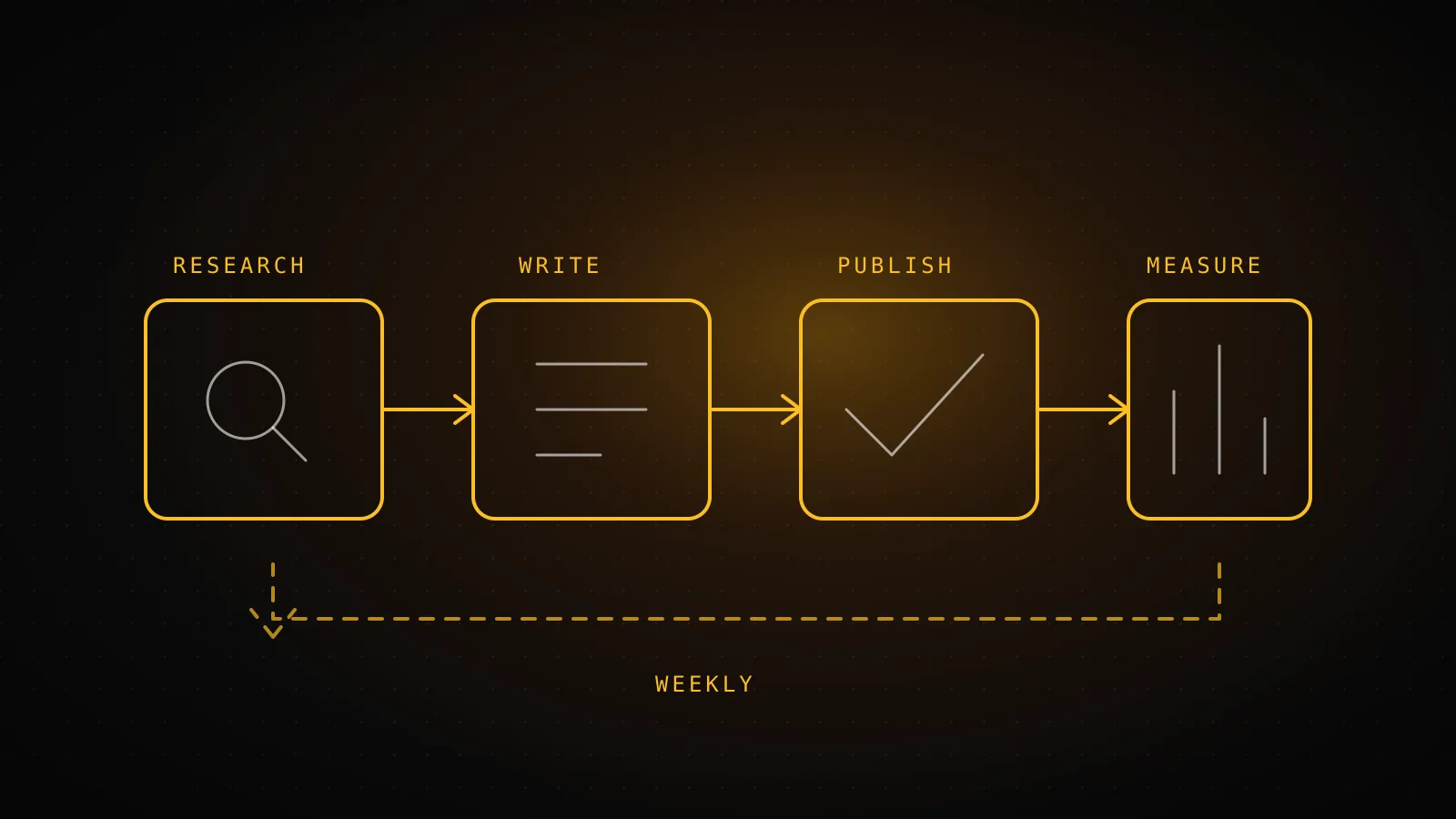
Content marketing for a SaaS with no team is one loop, run every week: pick a topic a buyer actually searches, publish a page that finishes their job, and read the numbers before choosing the next topic. The founders who see it compound are not the ones who publish the most. They are the ones who keep the loop going for months and prune what doesn't move.
TL;DR - Run one loop: research, write, publish, measure. Favor how-to and data-backed pages, and ration "alternative" pages. Judge by impressions and position for the first three months, not clicks. Kill a topic cluster after a few months of no movement. Automate the research, drafting and tracking; keep the product claims and the decisions.
What is content marketing for a SaaS when you are the only marketer?
It is the work of getting found by people who have the problem your product solves, and earning their trust before they are ready to buy. For a team that means an editorial calendar, a writer and a distribution plan. For one person it has to shrink to something you can repeat in a few hours a week.
- 1
Research
What would a buyer type?
One topic with a winnable page 1
- 2
Write
What does page 1 lack?
One page with a number or config of yours
- 3
Publish
Is it indexed?
A live URL in Search Console
- 4
Measure
Which queries gained position?
Keep, refresh or kill the topic
Repeat weekly - what Measure finds picks the next topic
Each stage asks one question and hands one thing to the next. If you can't answer a stage's question, you are not ready for the next stage - which is the quickest way to stop writing pages nobody needs. The wider year-long picture is in SEO for SaaS: a 12-month plan; this guide is the weekly engine inside it.
Why does most SaaS content go nowhere?
Three gaps, in the order they usually show up:
- No buyer intent. The topic came from "what we want to talk about," not from something a person types with a problem to solve.
- No cadence. Four posts in a burst, then six weeks of silence. Search engines and readers both learn to ignore a site that behaves that way.
- No measurement. Nobody opens Search Console, so nobody learns which of the pages is working and which should be rewritten.
All three are process failures, not talent failures, and a loop fixes them because it makes the next step obvious.
Which four kinds of page earn their place?
How-to for the job
Buyer has the problem, no tool yet
Overuse risk
Low - the safe default for most weeks
Comparison
Buyer is choosing a category
Overuse risk
Medium - needs first-hand detail
Alternative or migration
Buyer is leaving a tool
Overuse risk
High in volume - this site shipped 17 and paid for it
Data-backed opinion
Buyer wants a defended answer
Overuse risk
Low - but needs a real number
Start with how-to pages for the job your product does, and data-backed opinions where you have a real number to share. Comparisons are fine when you have used both sides. Alternative pages match a real buyer moment, but they are the cheapest to mass-produce, which is why they are the ones to ration. The pattern behind that caution is in the next section.
What does the weekly loop look like?
A workable week for one person:
- Research (about an hour). Write down what a buyer types, check page 1 for each phrase, and keep the one where page 1 is forums, thin posts or agency pitches. A keyword clustering tool helps once the list passes thirty phrases and you need to decide which belong on one page.
- Write (the long part). Answer the question in the first paragraph, then add something page 1 lacks: your own numbers, a config you ran, or a stance you can defend. Update older pages when facts change - content freshness covers what a useful refresh looks like.
- Publish. Ship it, submit or confirm the URL in Search Console, and link to it from two or three older related pages.
- Measure (twenty minutes). Open the Performance report, sort by impressions, and note which queries gained position. Rewrite the title of any page that shows often and never gets clicked.
One page a day is a ceiling, not a target. A pace you can hold to a quality bar beats a burst.
What did 75 published posts teach this site?
DispatchSEO's own blog is a useful counter-example. Here is its publishing record, counted from the frontmatter dates in the repo on 2026-10-10, next to the Search Console totals for the same site:
Guides published per month on dispatchseo.com
- July15
- August30
- September22
- October (to the 10th)8
Guides in the repo
75
37 of them about Claude Code or MCP, now off-topic
Impressions, 27 days
278
Search Console, to 2026-10-08
Clicks, 27 days
11
almost all on the homepage
The shape matters more than the totals. Thirty guides in August, many of them near-identical "alternative" pages and a large block on coding-agent topics that are not what the site is about. Search Console shows 278 impressions and 11 clicks over 27 days. The site owner's own read, recorded in the project's conventions, is that the alternative pages were followed by a sharp drop in impressions after Google's August 2026 spam update, and that the coding-agent guides never indexed or ranked.
I wouldn't draw a causal law from one site. What the record does support: volume without a topic, a mix and a measurement habit produced very little, and the fix was a narrower remit, not more posts. That is the argument for the loop over the calendar.
How do you measure content that takes months to pay?
Use leading indicators first:
- Weeks 1-4: is the page indexed? Search Console's URL inspection tells you.
- Months 1-3: impressions and average position per query. Position 60 moving to 35 over several weeks is progress even at zero clicks.
- Months 3-6: click-through rate on pages already on page 1 or 2, then signups from those pages.
Don't judge by a single month; impressions on a young site can swing by an order of magnitude with no change in your work.
When should you kill a topic cluster?
Give a cluster of three to five pages a few months. If none has gained position and page 1 is still out of reach, stop adding to it and spend the time elsewhere. If one page is creeping up, put the next page next to it instead. Refreshing a page sitting at positions 5-20 is usually cheaper than writing a new one.
What can you hand to automation, and what stays yours?
Tracking rankings and Search Console, queuing keyword ideas and drafting to a template are rule-bound and repeat weekly, so a schedule does them well. Claims about your product, pricing and screenshots, and the decision about what to publish, need you.
DispatchSEO is built on that split: it tracks Search Console on a schedule, queues ideas for your coding agent (Claude Code or Codex) to build as pull requests from your repo, and leaves approving and merging to you. If you are still deciding whether to do this alone, can you do SEO on your own covers the hours, and best SEO tools for beginners lists the free tools for the measuring half.
When is content marketing the wrong channel?
If your product is new and has no audience, talking to ten prospects directly validates demand faster than a three-month wait. If nobody searches for your category yet, there is nothing to rank for. And if you can't commit to several months of steady work, the early effort is mostly wasted.
FAQ
What is content marketing for SaaS? Publishing pages that answer questions your buyers search for, so they find and trust you before they are ready to buy. For a small team that mostly means guides, comparisons and tools aimed at search.
How often should a SaaS publish content? A steady one to a few pages a week is a good start, and one a day is a ceiling. Consistency and a quality bar matter more than raw volume.
How long does SaaS content marketing take to work? Expect impressions in the first one to three months and meaningful clicks later, often months 4-7 for a new site without links. Nothing here is guaranteed.
Can one person run SaaS content marketing? Yes, with a weekly loop and a Search Console habit. Automation can take on the research and drafting.
Which metrics matter first? Indexing, then impressions and average position per query. Clicks and signups follow once pages reach page 1 or 2.