Best SEO automation tools, grouped by what they actually automate
6 min read
On this page
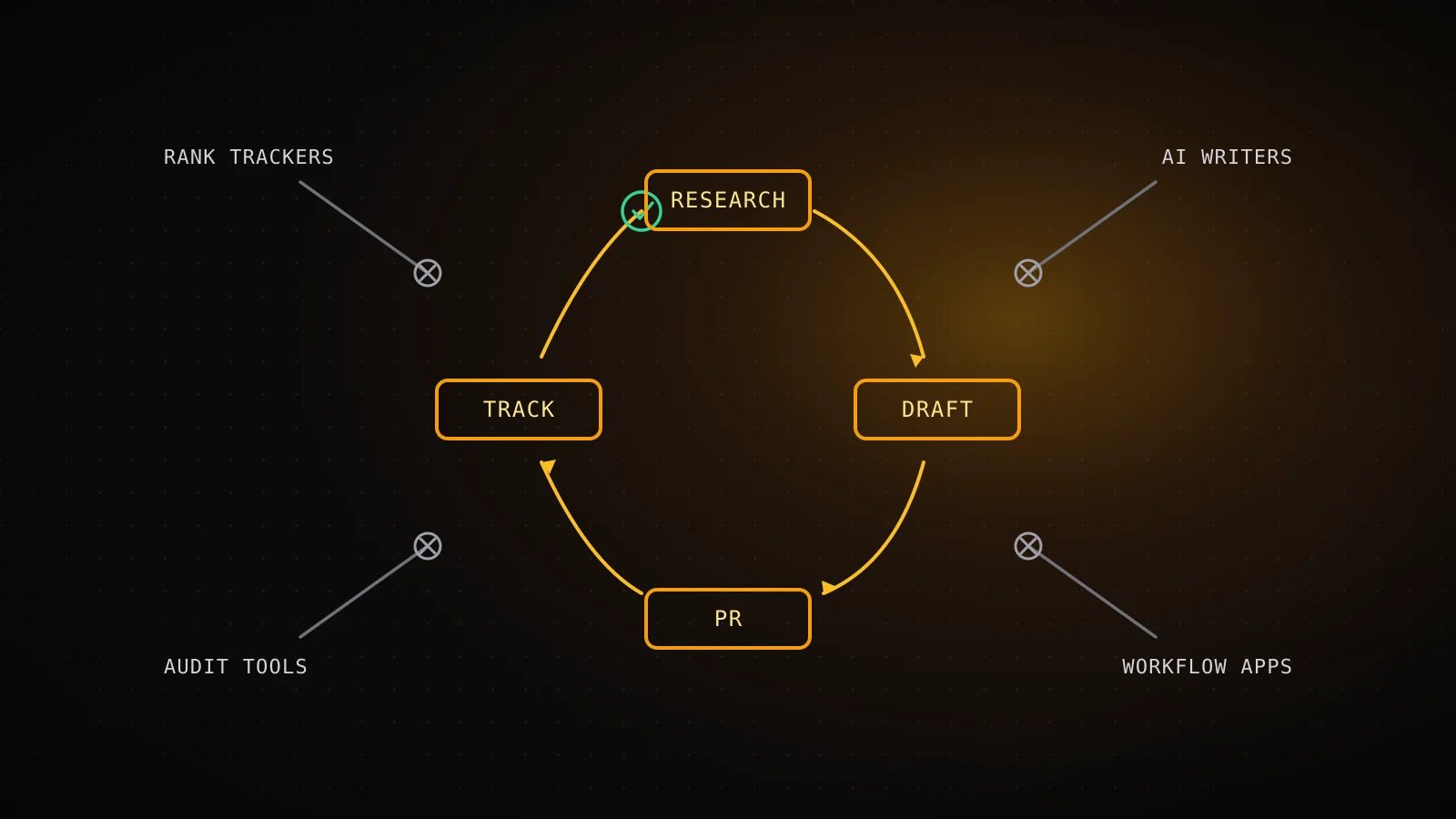
"Best SEO automation tools" sounds like one shopping list, but today's page 1 is really four different jobs wearing the same label: rank trackers that watch positions, AI writers that draft text on request, workflow platforms you wire together yourself, and audit suites that crawl for technical problems. Each one automates its own slice and hands the rest of the job back to you - you still decide what to write, you still publish it, you still check whether it worked. This guide sorts the field by what each category actually takes off your plate, then covers the one shape none of them are: a system that runs research through a published, tracked page without a person doing each step by hand.
TL;DR - Page 1 for "best SEO automation tools" splits into listicles (4 of 9 organic results), vendor product pages (3 of 9 - a workflow-automation platform, an audit suite, and a buying-guide vendor), one forum thread, and one review directory. None of them close the loop from research to a shipped, tracked page - each automates one job and leaves the rest manual. DispatchSEO is the worked example of the missing shape: this exact guide went from a proposed keyword to an opened pull request without anyone opening a dashboard, and the timeline below shows the real timestamps, not a pitch.
The four categories hiding under "SEO automation tools"
Pulled live off page 1 for this exact query - positions 1 and 8 are omitted because DataForSEO returned them as a non-organic block, not because they were skipped:
marketermilk.com
"13 best SEO automation tools I'm using in 2026"
gumloop.com
"SEO automation made simple with AI agents"
siteimprove.com
"Unlocking the Power of SEO Automation and Optimization..."
morningscore.io
"The 20 best SEO tools in 2026? I personally tested all tools"
reddit.com
"What SEO tool is best for automating SEO articles?"
onelittleweb.com
"I Tested 40+ AI SEO Tools. These 15 Actually Work (2026)"
rabbitseo.com
"How to Choose the Best SEO Automation Tool (2026 Guide)"
zapier.com
"The 11 Best SEO Tools in 2026"
g2.com
"Best SEO Tools: User Reviews from August 2026"
Four listicles round up other vendors' tools. Three are vendor pages: Gumloop sells general-purpose AI workflow automation with SEO as one use case among many, Siteimprove sells technical and accessibility crawling at enterprise scale, and RabbitSEO runs its own "how to choose" buying guide. One is a Reddit thread asking the same question this page answers, and one is G2's review directory. Nothing here is wrong for what it's built to do - the gap is that none of the nine names a system that goes all the way from a keyword to a published page on its own.
What each category automates - and what's still yours
- Automates
- Checking position, building the dashboard
- Still yours
- Deciding what to write, publishing it, judging if it worked
- Automates
- Producing draft text on request
- Still yours
- Research judgment, fact-checking, review, actually shipping
- Automates
- Running a flow you design between steps
- Still yours
- Designing that flow, and every SEO decision inside it
- Automates
- Crawling for broken links, schema, accessibility flags
- Still yours
- Everything content-related - research, writing, tracking
The pattern holds across all four: automation stops at the edge of the category's one job. A rank tracker never decides what to write about a position it just flagged. A workflow platform runs the steps you already designed, but the designing is still yours. An AI writer produces a draft; whether that draft was worth writing, and whether it ever gets published, is a decision nothing in these categories makes.
Closing the loop: this guide's own trip from queue to page
DispatchSEO is built to be the fifth category - not a bigger version of any of the four above, but the thing none of them are: research, drafting, and publishing as one system instead of four separate tabs. The architecture behind that split is covered in depth elsewhere; here's what it looks like for one specific page, this one.
Seconds from proposed to approved
31
research flagged this keyword and auto-approved it in the same session - no dashboard click
Days from approved to built
13
the wait was the one-guide-a-day pace, not a backlog nobody looked at
Guides still queued behind this one
6
already researched, already approved, waiting for tomorrow's slot and the days after
"Best seo automation tools" was proposed and auto-approved by a research run on July 30, sat in the approved queue for 13 days because the pace is capped at one guide a day, and reached its build slot today - the same run that pulled the live SERP above, wrote this sentence, and will open the pull request this guide ships as. No dashboard tab got opened in between; the queue is the whole interface.
Where the category tools still win
None of this makes the other four categories wrong for what they're built for. Siteimprove's crawl-scale technical and accessibility audits are a real capability DispatchSEO doesn't have and isn't trying to build - there's no site-wide crawl here, only keyword research and content. Gumloop's general-purpose workflow automation is genuinely broader: it's built to automate tasks across marketing, ops, and support, not just one content loop. And a team managing rank tracking across a dozen client sites through a shared login, the way Mangools bundles seven tools under one, still needs that shared dashboard - one project's queue isn't built for that either.
Worth saying plainly, since a pitch that skips its own numbers isn't an honest one: this site's own dashboard shows 4,302 impressions and 0 recorded clicks over the last 28 days. That's the normal cold-start curve for a 26-day-old domain, not a growth hack, and it's the same honest-numbers habit every guide on this site follows - including the keyword research step that feeds this loop, which runs the same "check, don't assume" rule on a much smaller job.
FAQ
What categories do "best SEO automation tools" lists actually cover? Four, once you sort page 1 by what each result actually is rather than its own marketing copy: rank trackers and reporting dashboards, AI writers and content tools, workflow-automation platforms, and technical or accessibility audit suites. The listicles themselves are a fifth thing - roundups, not tools.
Does any tool on page 1 go from keyword research to a published, tracked page without a person doing each step? Not among today's results - each one automates a single job and stops. DispatchSEO's own loop (research, propose, build a pull request, track the outcome) is built to close that whole path, gated only by the pull request a person still reviews before it merges.
How is a workflow-automation platform like Gumloop different from a dedicated content loop? Gumloop automates the steps you design - you still build the flow and make every SEO call inside it. A dedicated content loop already knows the SEO steps, so there's no flow to design in the first place.
Does DispatchSEO overlap with a technical or accessibility audit suite like Siteimprove? No. Siteimprove crawls a site for broken links, schema errors, and accessibility issues at scale. DispatchSEO doesn't crawl for technical problems - it researches keywords, drafts guides and tools, and tracks whether they rank.
Should DispatchSEO itself be on a "best SEO automation tools" list? Not one built on today's ranking authority - it's not on page 1 for this query, and this guide isn't pretending otherwise. What it's making the case for is the missing category: a system that closes the loop instead of automating one slice of it, shown here with the real queue timeline that built this exact page.
Sort today's "best SEO automation tools" results by what they actually do instead of the label on the tin, and the four categories cover measuring, writing, wiring, and auditing - never the whole path from a keyword to a page someone can check the results of. That path is the one job none of the nine results do end to end, and it's the only job this guide's own software was built for.