The best keyword clustering tools still leave you holding the clusters
9 min read
On this page
Type "keyword clustering tool" into Google and the results split into two piles: two roundup posts ranking six or seventeen clustering tools against each other, and the tools themselves - one paid module bolted onto a bigger SEO suite, three free standalone widgets, and a Reddit thread asking what people actually use instead. Nine organic results, checked live while writing this guide. Five of them are genuine, currently-live tools this page checked directly on their own pages, not summarized from a roundup: SE Ranking's Keyword Grouper (paid), ryrob.com's Keyword Cluster Tool, KeySearch's Keyword Cluster Tool, SEO.AI's Topic Cluster Tool, and DispatchSEO's own free clustering tool (the other three, free). Every one of them does the grouping job well and stops at the exact same wall.
TL;DR - Five real, currently-live keyword clustering tools sit on page 1 for this query, alongside two roundup posts and a Reddit thread cataloguing more of them. Checked directly on each tool's own current page, not assumed: every one hands back a grouped list and stops there - SE Ranking's own page says so outright, and the three free tools each push the "what to actually write" decision back onto whoever pasted the keywords in. DispatchSEO's free clustering tool does the exact same thing. What's different is the backend research workflow behind it, not the free web tool - it turns a cluster into a proposed page and, if the draft clears a live SERP check, a merged PR. This page is what that workflow does when pointed at its own keyword.
Two piles on page one, and what each one promises
lowfruits.io's "5 Best Keyword Clustering Tools" and keywordinsights.ai's own "17 Best Keyword Clustering Tools" are the two roundups holding positions 2 and 7 - both real, tested reviews rather than thin listicles, and keywordinsights.ai's methodology is explicit about it: clustering quality weighted highest, then cluster quantity, workflow integration, input flexibility, and processing speed, with tools further split by technique (pattern-based, semantic, AI/LLM, SERP-based). Its own top picks still land on a clustering product, not a publishing one - "Keyword Insights Pro" at roughly $58 a month tops the list, with Ahrefs Keywords Explorer as the fastest processor at under a minute. "Workflow integration" is graded as how easily a cluster feeds a content brief, not whether anything gets written or shipped from it. A Reddit thread at position 4 asks, in plain words, "what tools do you use for clustering keywords" - a working SEO going straight to a forum instead of trusting a vendor's own pitch, which is as honest a signal as page 1 offers that the roundups haven't settled the question either.
Five tools, one job: group keywords, hand back a list
| Tool | Price | Output | After you have the clusters |
|---|---|---|---|
| SE Ranking Keyword Grouper | Paid - Core plan from $103.20/mo | Grouped keywords, named by top-volume term | Stops at the list; a separate Content Editor add-on covers writing |
| ryrob.com Keyword Cluster Tool | Free, rate-limited hourly | Keyword map - image or CSV export | Suggests using clusters "when outlining a post"; upsells RightBlogger |
| KeySearch Keyword Cluster Tool | Free standalone | Related-term groups by shared intent | "Use each cluster to guide" one post per cluster - you write it |
| SEO.AI Topic Cluster Tool | Free, no login | Pillar topic + subtopic clusters | You build the pillar page and each subtopic piece yourself |
| DispatchSEO's own free tool | Free, runs in the browser | Same-page / sections / standalone verdict per pair | Same wall as the rest - see why below |
Checked directly on each tool's own current page, not a roundup's summary of it - the two review posts also on page 1 (lowfruits.io, keywordinsights.ai) catalogue more tools than this, but neither one checks what happens after the list the way this row does.
Zenbrief also holds a page-1 slot (position 6), but its page returned nothing to verify past the title - left out of the table above rather than guessed at. That's the shape of this field generally: one specialist incumbent most reviewers agree on (keywordinsights.ai), a paid module riding inside a bigger suite (SE Ranking), and a scatter of small, single-purpose free tools built by individual SEOs and content-tool makers rather than category leaders - a genuinely fragmented field, not a crowded one.
What each one says happens next, on its own page
This is the part no roundup checks, because it means reading five different products' own pages instead of running five different products through one scoring rubric. Quoted or closely paraphrased from what each tool's current page actually says:
- SE Ranking: the grouping tool itself "stops at the grouped list" - its own page is explicit that writing and publishing happen in a separate, paid Content Editor add-on. The clustering step is priced and positioned as SEO architecture planning, not content production.
- ryrob.com: after clusters generate, the page recommends using them "when coming up with topics and titles" and "when you're outlining a post" - guidance for a person still about to write, plus repeated upsells toward RightBlogger, the paid version.
- KeySearch: "use each cluster you've generated to guide the creation of comprehensive blog posts or pages... each post should target the main keyword in the cluster." One cluster becomes one post - written and published by whoever pasted the list in.
- SEO.AI: the tool hands back a pillar topic plus subtopic clusters, then tells you to "create a pillar page" and "develop individual content pieces for each cluster subtopic" yourself, with its paid suite offered for the writing step.
- DispatchSEO's own free tool: same wall. It returns a same-page, sections, or standalone verdict for each pair you paste in - no writing, no publishing, nothing after the verdict. It would be dishonest to hold this page's own free tool to a different bar than the four above it.
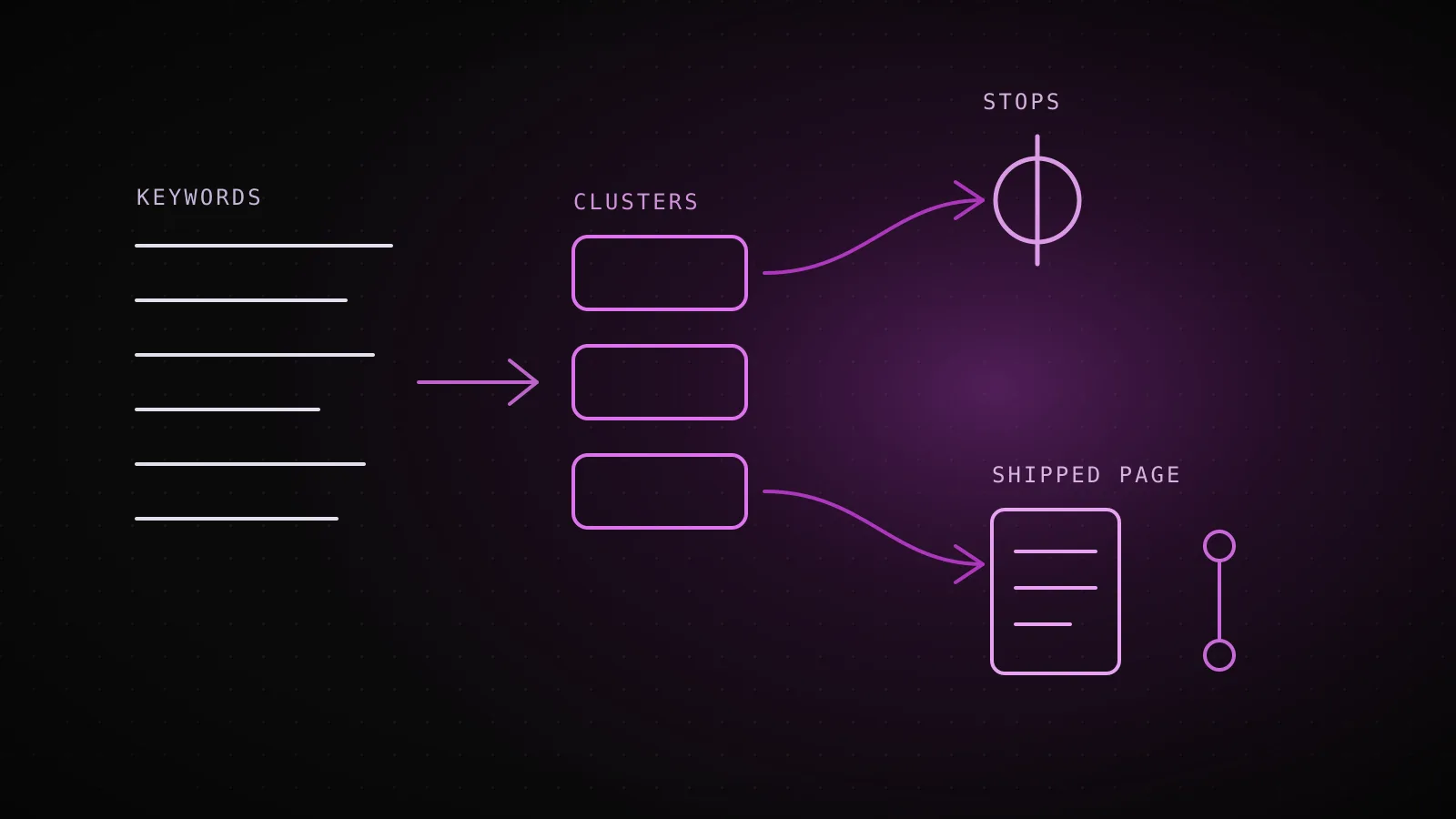
Five tools, five separate pages, one unanimous answer: clustering quality is a solved problem across this whole field. The decision that comes after it - which cluster earns a page, in what words, published where - is a human's job on every one of them, including this site's.
This project's own tool, run for real on a ten-keyword list
The clustering logic behind DispatchSEO's free tool lives in one pure function - no network calls, just term overlap - so it's checkable instead of just described. Run directly against a mixed test list while writing this guide:
node --experimental-strip-types scripts/cluster-test.mjs
Input: ten real keywords spanning two topics - clustering-tool searches and rank-tracking searches, deliberately mixed to see where the algorithm draws the line.
10 keywords in
4 clusters out
2 multi-keyword groups, 2 standalone
Largest cluster
6 keywords
"sections" verdict - 0.30 avg overlap
Same-page bar
0.60 similarity
Nothing in this run crossed it
The algorithm's own constants, read straight from src/lib/keyword-clustering.ts: two keywords join a cluster at 0.25 Jaccard term overlap or higher, and a cluster only earns the stronger "same page" verdict at 0.60 or above - otherwise it's "sections," related enough to share a page without being flattened into one. On this run, "best keyword research tool" and "keyword research tool free" pulled into the same six-keyword cluster as three keyword-clustering queries, purely on shared vocabulary ("keyword," "tool," "free") rather than matching search intent - a real, honest limitation of overlap-based clustering worth knowing before trusting any tool's verdict without a second look, this one included.
Clustering as a step, not a stop
Keyword list pasted or pulled in
Same starting point for every tool here
Any tool above
Clusters returned
Grouped list, CSV, or a pillar/subtopic map
Waits for a person
Someone still decides which cluster is worth a page
DispatchSEO's workflow
Clustered and prioritized
Same term-overlap step, inside the research run
Suggestion proposed, SERP-gated
Only queued if a draft could beat page 1
PR opened, rank tracked
Merge-ready page, then a nightly position check
None of the five tools above are wrong to stop where they stop - a clustering tool's job is clustering, and asking one to also write and publish would be asking it to be a different product. The gap is that nothing on page 1 closes that loop, including a standalone tool that tried to. DispatchSEO's research workflow runs the same kind of term-overlap step this page's own free tool does, but as one stage inside a longer run: suggest_keywords and keyword_ideas surface the raw list, clustering and prioritization decide what's worth pursuing, propose_suggestion queues the winners, and - the part every tool checked above stops short of - a live SERP re-check and a thin-content gate decide whether a draft is actually worth shipping before an agent writes and opens the PR. It's the same "one keyword, one decision" shape this project's programmatic-SEO guide argues for over a template-and-dataset merge, just starting one step earlier - at the raw keyword pile instead of the single decided keyword.
Which one to actually open
Reach for a standalone tool - SE Ranking if clustering is one line item inside a suite you already pay for, one of the three free ones if it's a single afternoon's job - when the output is going into a spreadsheet a person or a team will work from by hand, especially across several unrelated clients or niches in one sitting; none of the five tools checked here, DispatchSEO's included, are built for that fan-out. Reach for a workflow that clusters and ships instead when the job is narrower and repeats: one site's own keyword pile, decided and built into pages on a schedule, without reopening a spreadsheet every time a new batch of ideas shows up.
The honest caveat, on this project's own numbers: this domain is 32 days old, and its total organic footprint over the last 28 days is 3 clicks against 7,343 impressions across every keyword it tracks - clustering the right keywords doesn't fast-forward the part where a young site earns trust one ranked page at a time. A better cluster doesn't buy that back; it just means the queue behind it is pointed at the right spreadsheet row.
FAQ
What's the actual best keyword clustering tool? It depends on what happens after the list. For clustering quality alone, keywordinsights.ai's own review (checked live for this guide) rates its paid Keyword Insights Pro tier highest at roughly $58/month; for free and standalone, KeySearch, SEO.AI, ryrob.com, and DispatchSEO's own tool all group correctly with no signup. None of the five carries you past the list itself.
Is there a free keyword clustering tool with no signup? Yes - four of the five checked directly for this guide are free with no login: ryrob.com (hourly rate limit), KeySearch, SEO.AI, and DispatchSEO's own tool, which runs entirely in the browser and never uploads what you paste.
Does any keyword clustering tool also write or publish the content? Not the tools themselves - none of the five checked here does. SE Ranking, ryrob.com, KeySearch, and SEO.AI all explicitly hand the "write it" decision back to a person. DispatchSEO's free tool does too; the part that doesn't stop there is the separate research workflow, which clusters as one step inside proposing, SERP-gating, and building a page.
How does DispatchSEO's own clustering tool decide what belongs together?
Jaccard overlap on stripped-down word and two-word-phrase sets from each keyword - the exact code is in src/lib/keyword-clustering.ts. Two keywords join a cluster at 0.25 overlap or more; a cluster only earns a "same page" verdict, rather than "sections," at 0.60 or above.
Can this kind of clustering get it wrong? Yes, and a real run for this guide shows it: two keyword-research queries pulled into a keyword-clustering cluster on shared words like "keyword" and "free" rather than matching intent. Term overlap is a fast, honest heuristic, not a guarantee - worth a second look before trusting any tool's verdict blindly, this one included.
Every tool that held page 1 for this query, checked directly instead of taken on faith, does the same job well and stops in the same place. The gap isn't a better algorithm - it's what happens the moment the clusters come back, which is the part a spreadsheet was never going to do for you.